Wednesday, 10 December 2014

Jewish Boyz: Props

Prop design was very simple from the get-go because I had to gather props based on the lyrics I wrote. Without these props, the lyrics wouldn't have been perfectly executed in the video and they needed the props to come across as humorous as possible. 

Props, like costumes and location, are an important factor of Mise-En-Scene and in order to make the video seem as professional as possible, they were needed when relevant.

These are the props used in the video:


CUE CARDS
CHALLAH LOAF
TEN COMMANDMENTS
TABLE
DESK, PAPER AND PENCIL
REMOTE AND CHAIR
DREIDELS AND CHOCOLATE COINS
MILA KUNIS CUTOUT


Monday, 1 December 2014

Jewish Boyz: Costumes

When it came to costume design, I had already had an idea of what I wanted it to be from the initial music video idea. It had to be a bunch of casual looking Jews, who also had that Orthodox element and look about them, as this was part of the parody. My inspirations came from Holy Rollers and Les Aventures de Rabbi Jacob on how they could look to dress, with a Hasidic fedora and payot coming down from the sides, because my cast do not have natural payot. Here is the link to where I bought these hats from:

HATS


I then had to get shirts for the cast to wear in order to match the look of a Hasidic Jew. I also wanted to relate the costume to We Dem Boyz as much as possible, so I decided that I would copy the design of his t-shirts in his video, but with a difference. The shirt that Wiz Khalifa wears in his video says (on both sides) "Dem Boyz 93" and I am unaware if the number 93 has a specific meaning or not, however that isn't relevant to the parody:


The variation I made with my shirt was by writing on the back "Jewish Boyz 613" in the same calligraphy: 


The reason for this is because it was the name of the song on the back, just like Khalifa's, and the number 613 means the number of good deeds that can be done by a Jewish person in Judaism. I thought this was a significant number and a number that the Jewish section of the audience would be able to figure out. 

As I mentioned already, the front of Wiz's shirt is exactly the same. However, I didn't want to make mine the same because it would lack creativity if I imitated it exactly, as well as being an indication of complete plagiarism. Therefore, I decided to have ABOUDY written in Hebrew on the front, along with a Star of David and a pair of Shabbat candles as an extra design:


I also created shirts for the extra cast members so that theirs would also look different compared to the star's shirt. The design below features a name in Hebrew (didn't matter what name in particular), a smaller Star of David, a Menorah, and a dreidel:


I already had these shirts at home and they weren't being used, so it was cost-effective because I didn't have to pay for any extra. I also had enough for the whole cast which was useful. 

Those were the main parts of the costume that were needed throughout the entire video. However I also needed some extra costumes to cover some lines of the song.

For example, the beard was an added feature only meant for the star. The reason for this was because it was a prop/costume piece that would make him stand out and be noticeable. I also only had one fake beard so I was only able to give it to the star. Giving it to the star only was ultimately a better decision because if the entire cast had had one, it would have been slightly more confusing to understand who the star is:


The next example is the Sombrero and moustache, and the reason for the inclusion of these costumes is because of the line "Challah, challah, you drive me crazy (loco loco)". In Spanish, the word 'loco' means crazy, and because Mexicans speak Spanish, I decided to use a Sombrero and moustache to make the image iconic to the lyric (as the Sombrero/moustache look is iconic of Mexican culture, could also be seen as parodying Mexican culture briefly):


The final example is the baby hat and bib, and the reason for the inclusion of these costumes if because of the line "We Jews are famous, making loads of babies (here comes another one)". The idea was to parody the stereotype that Jews have multiple children, which tends to be true, however I wanted a baby costume on one of my cast members in order to add humour to the video:


Tuesday, 25 November 2014

Jewish Boyz: Narrative

Like most parodies, this narrative is based on the narrative of We Dem Boyz, however the video only has a minor narrative which is Wiz Khalifa "chilling with his boyz in the hood" whilst he raps, drinks, smokes weed and generally has a good time with his friends. In this case, the lyrics create the narrative rather than the video, which is an interesting approach to the song.

I felt that I needed to imitate this video making method in order to approach the parody in a successful way. I wrote the lyrics for the song in a similar style of the WDB lyrics and this was writing that told the narrative of the song and video entirely through the lyrics. The video then became a visualisation of the lyrics and also shared a theme with WDB. The theme essentially is a Hasidic Jew who is also "chilling with his boyz" but instead of "the hood", it's the Jewish areas of North-West London, such as Golders Green, Hendon, Edgware etc. This is the deifnition of the stereotypical aura that the song, lyrics and video have, and it follows a lyric-by-lyric narrative, as such:

CHALLAH, CHALLAH, WE'RE JEWISH BOYZ
CHALLAH, CHALLAH, KOSHER BOYZ


These lyrics aim to establish, just as Wiz did in his video/song, that they are Jewish Boyz, a title or status that epitomises a clique/group that they is sung about for audience envy, to make the audience want to feel as if they are a part of this group.

LET'S LAY THE TABLE (LAY THE TABLE)
ON SHABBAT DOING WORK, WE ARE NOT ABLE (WE'RE NOT ABLE)
WE CAN'T WATCH TV, NOT EVEN CABLE (NOT EVEN CABLE)

From this line onwards, the song becomes more educational, but mixes the element of stereotype into it so that it becomes a multi-purpose and humorous song. These lyrics in particular talk about Shabbat, a two-day period (Friday-Saturday) of religious observance and abstinence from work or any form of electricity/energy use. 

THE ONLY GAMBLIN' WE DO IS SPINNIN' DREIDEL (SPINNIN' DREIDEL)

These lyrics refer to the Jewish holiday of Hanukkah. It's also a humorous spin on the stereotype of gangster culture, some of which tend to gamble a lot. In Judaism, spinning dreidels for chocolate coins is the closest form of gambling that Jews are allowed to take part in.

THE REBBE MUST BE SERIOUS, CHALLAH
COME TO SHUL AND FACE YOUR FEARS, CHALLAH CHALLAH

There are some lyrics, like these, that have directly been taken from WDB and have been changed in order to fit the context of my song. Therefore, these lyrics reference how Rabbis are "serious" teachers and are wise, and one must go to Shul to face their fears (which according to Judaism is normally God).

DO IT JUST LIKE MOSHE WITH THE TEN COMMANDMENTS (SIDE BY SIDE)
WE WILL KEEP ON TEACHING 'TIL YOU UNDERSTAND IT (LAWS TO ABIDE)

Once again, these are lyrics slightly varied from the WDB. The references include a mention of the Exodus story, where Moses received the Ten Commandments from God to instruct upon the Jews during their slavery period in Egypt. The idea of continuous teaching refers to the idea that once a Jew has read the entire Torah (bible), they must repeat, and read it again until they understand something new that they did not understand the last time they read all of it.

SMELL IT FROM HERE, THE BRISKET'S READY (YEAH IT'S READY)
SUCH A GOOD SMELL WE CALL IT SEXY (DO WE REALLY?)
MAKING ME DROOL I'M QUITE UNSTEADY
BUT FIRST I GOTTA EAT THIS CHALLAH, BABY CHALLAH CHALLAH

The lyrics then change subject from a religiously heavy and educational topic, to a more commercial topic of eating brisket. The reason I included brisket in the lyrics was because I wanted to reach an audience that wasn't limited to British Jews and Jews from London, if I had included something that is more popular in the US, then there's a more likely chance of it spreading further. The recurring gag in this song is Challah, because it rhymes with Khalifa's way of saying "Hol' up" in WDB. This is the reason as to why it's repeated so much in the song.

OY VEY ZMIR, THAT IS AMAZING!

This lyric is an exact replica of WDB: "Oh my God, that is amazing!"

CHALLAH, CHALLAH, YOU DRIVE ME CRAZY (LOCO LOCO)
YOU'RE JUST LIKE NORMAL BREAD, BUT WAY MORE TASTY

These lyrics talks about the star's infatuation with Challah bread, and that it makes him crazy or "loco". What I did not take caution in doing was making sure that the audience wouldn't associate Mexicans with constant craziness, because that is a stereotype that I cannot address if I am not Mexican myself. However, I still had a member of cast dress up in a Sombrero and moustache in order to quickly shoot the shot of the lyric. 

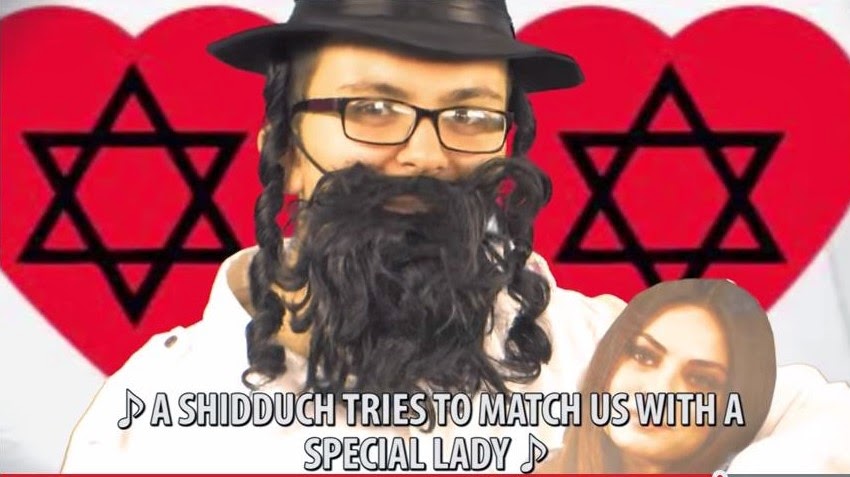
A SHIDDUCH TRIES TO MATCH US WITH A SPECIAL LADY (SPECIAL LADY)

A Shidduch is a person who matches Jewish men and women together so that they can eventually marry, a.k.a. Arranged Marriage. The special lady in the video happens to be a cut-out of Mila Kunis, and the reason for that is because she is a famous and attractive Jewish celebrity, and was the first person out of many in that category that I thought to include in the video, since we couldn't get her in real life.

WE JEWS ARE FAMOUS, MAKING LOADS OF BABIES (HERE COMES ANOTHER ONE)

These lyrics address the stereotype that Jewish families are large because of the amount of children they tend to have, which is true. The creation of these lyrics were unintentionally offensive and relate to the narrative generally because of the theme of stereotype addressing.

SOME BOYS THINK WE SO RICH THAT WE OWN MERCEDES (BENZ)
IN FACT I OWN A PEOPLE CARRIER WITH NO MORE SPACES (THERE'S NO ROOM FOR YOU)

Another stereotype is addressed here, and that is the negative attitude that non-Jewish people have towards Jewish people if they happen to be rich or successful in their jobs. This is not the case for all Jewish people! The Mercedes Benz is a reference to an expensive sports car that Jewish people are sometimes known for owning in the North-West London community. However, Jewish people across the UK and US are known for owning SUVs, which can carry lots of people, again reiterating the stereotype of large Jewish families. 

ON OCCASION I TAKE MY KIDS TO THE NURSERY 
OH WAIT IT'S MY TURN SOMEBODY SAVE ME!

These lyrics finish off the song and have no stereotype to address, as a form of finishing the song.


Wednesday, 19 November 2014

Arranging to meet for shooting day

Before filming certain shooting days, I had to speak to Elior (star) in order to meet him in the planned locations and make sure that he had all his costuming with him (as he had made his own parts of it), so here are the exchanges between him and me:


Tuesday, 11 November 2014

Lighting

Lighting is very important as it is able to reflect moods and is able to create ideas within the audience. The parody genre usually aims to make fun of upbeat and happier songs, there aren't that many parodies of sad songs that exist. The lighting usually is not specialised, however it tends to match the lighting used in the video it's trying to imitate. 

During a double Media lesson last year, we were brought to a lighting and colour workshop hosted by Mr Rosenberg in the media suite. The aim of the workshop was to teach us how to use lighting effectively when filming. We were taught about three main lights involved in filming:


Key light - First and usually most important. It is used to highlight the form and dimension of the subject. It shines directly upon the subject and serves as its principal illuminator; the strength, colour and angle of the key determines the shot's overall lighting design.

Fill light - Is used to reduce the contrast of a scene to match the dynamic range of the recording media and record the same amount of detail typically seen by eye in average lighting, what is considered normal. It also shines on the subject, but from a side angle relative to the key and is often positioned lower than the key which balances it by illuminating shaded surfaces and lessening chiaroscuro effects, such as shadow cast on the face and nose. It is softer than the key, preventing stark contrasts.

Back light - Is used to give the subject a rim of light to separate the subject from the background and highlighting contours. It shines on the subject from behind, often (but not necessarily) to one side or the other.


Mr Rosenberg then showed us how this would work practically:


We were also shown how the lights could be used against walls to give a different type of background image, which was an example use of colour effects. 


Colour is also extremely important when it comes to filming the thriller. The aim is to get the right colour in the right places so that the audience will react to the video as they would a professional film. First and most importantly, white balance must be retained, and without this, the colours of the video will be completely incorrect.

Mr Rosenberg also brought colour filters so we could see how to film with other colours. Colour filters aren't important for thrillers, but it gives us an idea of editing the clip to be in black and white.


When thinking about lighting for my music video, I knew that I was going to film a lot of it outside during the day, so natural lighting was going to assist me which would leave me no need to use that much artificial lighting. However, I then had to use the green screen in a studio, which required a lot of artificial light so that I could receive the best picture quality in order to place images clearly in editing. 

Wednesday, 5 November 2014

Music Video Tips

During the construction process of my music video plan, my teacher offered tips on how to create the most successful music video:

  • Essentially, you are manufacturing an artist for a song - but in my case, I am manufacturing a song for an artist - and this will be that artist's first release, so it's my job to make the video successful
  • Start with the image of the artist, ensure that their style is fit for the song - or that the song is fit for their style - and that the artist is able to realistically mime/lip sync to the track. Once this has been realised, a concept for the video can be decided, and one which will blend most with the music
  • The artist I am creating starts off with no fan-base at all, so it's my duty to spread the word about them, through various marketing techniques and through a cohesive package of the music video, Digi-Pak and website. As Henry Jenkins says:

    "If it doesn't spread, it's dead"
  • The best type of music video contains three different strands: 
  1. Performance element - the record labels believe this is vital as it acts as a fail save
  2. Lip sync element - Singing in a situation with very few props
  3. Narrative element - The story, which will be led by genre and style
  • The music video will then consist of constant cutting between these strands, in order to keep the video exciting and interesting
  • We were advised to create a 'mood film' or Prezi involving a set of images or a simple video to demonstrate ideas for the final product for clarification and identification of any potential problems

Sunday, 26 October 2014

Parody and Pastiche

The aim of my music video is to parody Wiz Khalifa's song, We Dem Boyz, and therefore I must know what a parody (and its opposite, a pastiche) actually is. This isn't just important for the blog, it's also important as terminology for the exam. Another important term I must be aware of in this case is "Intertextuality" because it is considered a type of pastiche.


Parody: An imitation of the style of a particular writer, artist, or genre with deliberate exaggeration for comic effect.

Examples: Movie and music parodies are very prevalent in current times as they bring a sense of nostalgia (mainly with movies) and humour to past artists' works. The most known movie parodies have been (and still are): Scary Movie (series), Johnny English (series, UK's best in current generation), and Spaceballs (parody of Star Wars, greatest film at time of release). The most known parody music artists at the moment are: "Weird Al" Yankovic, The Midnight Beast (UK), and Rucka Rucka Ali.  

Pastiche: An artistic work in a style that imitates that of another work, artist, or period.

Examples: George Lucas' influence for the Star Wars series was the film Metalstorm: The Destruction of Jared-Syn (1983). Ever since creation, Star Wars has been an influence on most post-modern movies. Queen's influence for Bohemian Rhapsody was Happiness is a Warm Gun by The Beatles.

Intertextuality: The interrelationship between texts, especially works of literature; the way that similar or related texts influence, reflect, or differ from each other.